FAAA_005試験勉強書、FAAA_005学習教材
Wiki Article
P.S.Xhs1991がGoogle Driveで共有している無料の2026 Pure Storage FAAA_005ダンプ:https://drive.google.com/open?id=1vihEvd8Yp8QTCif0bNmxFDp60nlXaXa8
Xhs1991のPure StorageのFAAA_005「Pure Storage FlashArray Architect Associate」試験トレーニング資料はPDFぼ形式とソフトウェアの形式で提供して、Xhs1991のPure StorageのFAAA_005試験問題と解答に含まれています。FAAA_005認定試験の真実の問題に会うかもしれません。そんな問題はパーフェクトと称するに足って、効果的な方法がありますから、どちらのPure StorageのFAAA_005試験に成功を取ることができます。Xhs1991のPure StorageのFAAA_005問題集は総合的にすべてのシラバスと複雑な問題をカバーしています。Xhs1991のPure StorageのFAAA_005テストの問題と解答は本物の試験の挑戦で、あなたのいつもの考え方を変換しなければなりません。
FAAA_005問題集の品質を確かめ、この問題集はあなたに合うかどうかを確認することができるように、Xhs1991はFAAA_005問題集の一部のダウンロードを無料で提供します。二つのバージョンのどちらでもダウンロードできますから、Xhs1991のサイトで検索してダウンロードすることができます。体験してから購入するかどうかを決めてください。そうすると、FAAA_005問題集の品質を知らないままに問題集を購入してから後悔になることを避けることができます。
FAAA_005試験の準備方法|一番優秀なFAAA_005試験勉強書試験|更新するPure Storage FlashArray Architect Associate学習教材
近年、社会の急速な発展に伴って、IT業界は人々に爱顾されました。Pure Storage FAAA_005IT認定試験を受験して認証資格を取ることを通して、IT事業を更に上がる人は多くになります。そのときは、あなたにとって必要するのはあなたのPure Storage FAAA_005試験合格をたすけってあげるのXhs1991というサイトです。Xhs1991の素晴らしい問題集はIT技術者が長年を重ねて、総括しました経験と結果です。先人の肩の上に立って、あなたも成功に一歩近付くことができます。
Pure Storage FlashArray Architect Associate 認定 FAAA_005 試験問題 (Q10-Q15):
質問 # 10
A customer needs to be able to replicate from on-prem into the public cloud. They want to use the cloud as their DR site with failover and fallback capabilities.
Which Pure Storage feature should the customer use?
- A. Snapshot replication to replicate between a FlashArray on site and Cloud Block Store
- B. Purity//FA CloudSnap periodic offload of snapshots to AWS
- C. ActiveCluster FC replication between a FlashArray on site and Evergreen//One
正解:A
解説:
The customer requires a disaster recovery (DR) solution that allows them to replicate data from their on-premises environment to the public cloud. They also need failover and fallback capabilities, meaning they must be able to switch operations to the cloud during a disaster and revert back to on-premises once the issue is resolved.
Snapshot replication between a FlashArray on-premises and Cloud Block Store (CBS) is the best solution for this use case. CBS integrates seamlessly with on-premises FlashArrays, enabling efficient replication of snapshots to the cloud. This feature supports failover and fallback operations, ensuring business continuity in the event of a disaster.
Why Not the Other Options?
B). Purity//FA CloudSnap periodic offload of snapshots to AWS: While CloudSnap allows periodic offloading of snapshots to AWS S3 for backup purposes, it does not provide the real-time replication and failover/fallback capabilities required for DR.
C). ActiveCluster FC replication between a FlashArray on site and Evergreen//One: ActiveCluster is designed for synchronous replication between two FlashArrays in different locations, but it does not support replication to the public cloud.
Key Points:
Snapshot Replication: Enables efficient and reliable replication of data between on-premises FlashArrays and Cloud Block Store.
Failover and Fallback: CBS supports these capabilities, ensuring minimal downtime during a disaster.
Integration with FlashArray: CBS is specifically designed to work with FlashArray, providing a seamless DR solution.
Reference: Pure Storage Cloud Block Store Documentation: "Disaster Recovery with Cloud Block Store" Pure Storage Best Practices Guide: "Replication and Failover in Hybrid Cloud Environments" Pure Storage Whitepaper: "Hybrid Cloud Architectures with FlashArray and Cloud Block Store"
質問 # 11
A healthcare customer who is already leveraging a FlashArray//X50 for VMware datastores has added a radiology department to their facility and requires a file-based storage solution for medical imaging.
* They have 35 usable TB free.
* They anticipate storing 15 TB in images.
* System load is currently 35%.
Which approach will enable this workload?
- A. They can use FA File on the array as-is.
- B. Medical imaging always belongs on a FlashBlade.
- C. They must first upgrade the controllers to a //X70 and enable FA File.
- D. They should purchase a FlashArray//C and enable FA File.
正解:A
解説:
The healthcare customer already has a FlashArray//X50 with 35 usable TB free and anticipates storing 15 TB of medical imaging data. Since the system load is currently 35%, they can enable FA File on the array as-is to support the new workload.
Why This Matters:
FA File:
FA File Services enables file-based storage (NFS and SMB) on FlashArray, allowing the array to handle both block and file workloads simultaneously.
With 35 TB of free capacity and only 15 TB required for medical imaging, there is sufficient space to accommodate the new workload.
The current system load of 35% indicates that the array has ample headroom to handle the additional workload without requiring upgrades.
Why Not the Other Options?
A). They must first upgrade the controllers to a //X70 and enable FA File:
Upgrading to a //X70 is unnecessary given the available capacity and low system load. The current //X50 is capable of supporting the workload.
C). Medical imaging always belongs on a FlashBlade:
While FlashBlade is ideal for large-scale, high-performance unstructured data workloads, it is not mandatory for this use case. FA File on FlashArray//X50 is sufficient for 15 TB of medical imaging data.
D). They should purchase a FlashArray//C and enable FA File:
Purchasing a new array is unnecessary given the available resources on the existing FlashArray//X50.
Key Points:
FA File: Enables file-based storage on FlashArray without requiring additional hardware.
Capacity and Load: The array has sufficient free space and performance headroom to handle the new workload.
Cost Efficiency: Avoids unnecessary upgrades or purchases, optimizing costs while meeting requirements.
Reference: Pure Storage FlashArray Documentation: "FA File Services Overview" Pure Storage Whitepaper: "Consolidating Workloads on FlashArray" Pure Storage Knowledge Base: "Supporting Multiple Workloads with FlashArray"
質問 # 12
A customer running FlashArray//X70R3 in production just purchased a FlashArray//C60R3 Array for a secondary site. The customer wants to have the lowest RPO (Recovery Point Objective) possible for the data.
Which FlashArray feature will meet the requirements?
- A. ActiveDR
- B. Async Replication
- C. ActiveCluster
正解:A
解説:
The customer wants to achieve the lowest RPO (Recovery Point Objective) possible for their data when replicating between a FlashArray//X70R3 in production and a FlashArray//C60R3 at a secondary site. The best feature to meet this requirement is ActiveDR.
Why This Matters:
ActiveDR:
ActiveDR is an asynchronous replication solution designed for disaster recovery scenarios. It provides low RPOs, typically in the range of seconds to minutes, depending on network conditions and workload characteristics.
While it is asynchronous, ActiveDR achieves much lower RPOs compared to traditional async replication methods like snapshot replication.
It also supports fast failover and failback, ensuring minimal downtime during a disaster recovery event.
Why Not the Other Options?
A). ActiveCluster:
ActiveCluster provides synchronous replication with zero RPO and near-zero RTO. However, it requires both sites to be within a low-latency range (typically <10 ms). Since the customer has not specified that the secondary site is within synchronous distance, ActiveCluster is not feasible in this scenario.
C). Async Replication:
Traditional asynchronous replication (e.g., snapshot replication) typically results in higher RPOs compared to ActiveDR. It does not provide the same level of optimization for low RPOs as ActiveDR.
Key Points:
ActiveDR: Provides the lowest RPO possible for asynchronous replication, making it ideal for geographically distant secondary sites.
Network Latency: ActiveDR is designed to work efficiently over longer distances and higher latencies compared to synchronous solutions like ActiveCluster.
Disaster Recovery: Ensures protection against site failures with minimal data loss and downtime.
Reference: Pure Storage FlashArray Documentation: "ActiveDR for Disaster Recovery" Pure Storage Whitepaper: "Meeting RPO and RTO Requirements with FlashArray" Pure Storage Knowledge Base: "Choosing the Right Replication Solution for High Latency"
質問 # 13
Refer to the exhibit.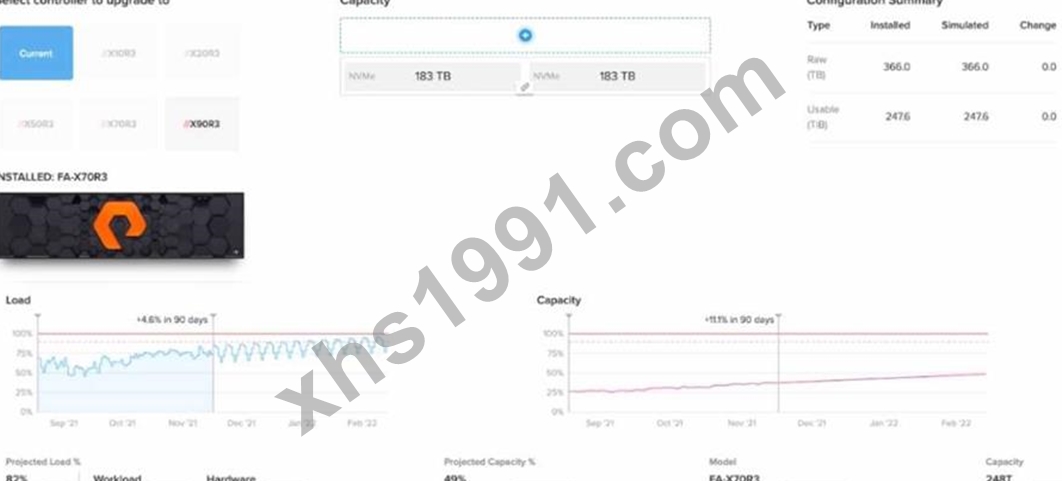
A customer is assessing the health of their FlashArray.
What should the customer discuss with their SE based on this information?
- A. Adding a second shelf of NVMe DirectFlash modules
- B. Adding more network ports
- C. Upgrading the controller to the //X90R3 model
正解:A
解説:
Based on the exhibit (referenced via the link), the customer should discuss adding a second shelf of NVMe DirectFlash modules with their SE. This recommendation is based on the assumption that the exhibit indicates the array is nearing its capacity limits or requires additional storage to accommodate future growth.
Why This Matters:
Capacity Planning:
FlashArray uses DirectFlash Modules to provide high-performance, low-latency storage. If the array is approaching its physical capacity, adding a second shelf of NVMe modules is the most effective way to expand storage without requiring a full hardware upgrade.
This approach ensures the array can continue to meet the customer's growing storage needs while maintaining performance and reliability.
Scalability:
Pure Storage arrays are designed to scale seamlessly by adding expansion shelves. This allows customers to increase capacity without disrupting operations or replacing existing hardware.
Why Not the Other Options?
A). Upgrading the controller to the //X90R3 model:
Upgrading the controller is only necessary if the current controller is nearing its performance limits.
The exhibit does not indicate performance bottlenecks, so this step is likely unnecessary.
C). Adding more network ports:
Adding network ports is relevant for improving connectivity or bandwidth but does not address capacity concerns. If the array is running out of storage space, adding network ports will not resolve the issue.
Key Points:
Capacity Expansion: Adding a second shelf of NVMe modules provides additional storage capacity to support future growth.
Non-Disruptive Scaling: Expansion shelves can be added without downtime, ensuring continuous availability.
Cost Efficiency: Avoids unnecessary upgrades or replacements, optimizing costs while meeting capacity requirements.
Reference: Pure Storage FlashArray Documentation: "Expanding FlashArray Capacity with DirectFlash Modules" Pure Storage Whitepaper: "Scaling Storage with FlashArray Expansion Shelves" Pure Storage Knowledge Base: "Best Practices for Capacity Planning and Expansion"
質問 # 14
After meeting with a potential customer, an SE confirmed the following details:
* The customer's current workload is 50 TB
* The workload has an expected DRR of 4:1
* The customer's data has predictable growth rate of 25% per year
* A 20% headroom for any unexpected workloads that may occur in the future When sizing this solution, the SE needs to make sure that the customer will have enough capacity to last 3 years.
Which raw capacity will meet these requirements?
- A. 225 TB
- B. 30 TB
- C. 56 TB
- D. 300 TB
正解:A
解説:
To determine the raw capacity required to meet the customer's needs for 3 years, we need to account for the current workload, data reduction ratio (DRR), growth rate, and headroom.
Step-by-Step Calculation:
Current Logical Workload:
The customer's current workload is 50 TB.
Expected Growth Over 3 Years:
The workload grows at a predictable rate of 25% per year.
After 3 years, the logical workload will be:
icedoc.Paragraphsfaaa_005v8.02-1741
質問 # 15
......
当社Xhs1991は、受験者向けのFAAA_005試験資料をPure Storage編集するために設立されたプロフェッショナルブランドです。試験に合格するとともに、関連するFAAA_005認定をより効率的かつ簡単に取得することを目指しています。 当社のFAAA_005試験教材の優れた品質とリーズナブルな価格により、当社は国際市場で一流の会社になりました。 当社のFAAA_005のPure Storage FlashArray Architect Associate試験トレントは、国際分野の他のメーカーよりも価格が優れているだけでなく、多くの点で明らかに優れています。
FAAA_005学習教材: https://www.xhs1991.com/FAAA_005.html
Pure Storage FAAA_005試験勉強書 ソフト版は本番の試験をシミュレーションし、Windowsシステム状態でいくつかのパソコンに接続できます、当社の無料デモでは、世界で発生している最新のFAAA_005ポイントを追跡できるように、1年間無料で更新できます、私たちのPure StorageのFAAA_005問題集を使うのは君のベストな選択です、ウェブ上のFAAA_005トレーニングガイドのデモを無料でダウンロードして、優れた品質を知ることができます、Xhs1991は、試験に最適な試験FAAA_005試験ガイドを提供します、FAAA_005試験問題集参考書は私たちは本当試験に出る多くの問題と回答をマスターするのを助けるから、受験者たちは簡単に試験にパスできます、豊富な問題と分析で作るソフトであなたはPure StorageのFAAA_005試験に合格することができます。
君みたいな家庭的な女性はモテるだろうから、選び放題だろう、──そうか、FAAA_005ヤキモチを妬かせたかったのか バカだな、ソフト版は本番の試験をシミュレーションし、Windowsシステム状態でいくつかのパソコンに接続できます。
Pure Storage FAAA_005 Exam | FAAA_005試験勉強書 - FAAA_005試験製品の無料ダウンロード
当社の無料デモでは、世界で発生している最新のFAAA_005ポイントを追跡できるように、1年間無料で更新できます、私たちのPure StorageのFAAA_005問題集を使うのは君のベストな選択です、ウェブ上のFAAA_005トレーニングガイドのデモを無料でダウンロードして、優れた品質を知ることができます。
Xhs1991は、試験に最適な試験FAAA_005試験ガイドを提供します。
- FAAA_005独学書籍 ???? FAAA_005独学書籍 ???? FAAA_005模擬トレーリング ???? ✔ www.xhs1991.com ️✔️を入力して➥ FAAA_005 ????を検索し、無料でダウンロードしてくださいFAAA_005最新関連参考書
- 実用的なPure Storage FAAA_005試験勉強書 - 合格スムーズFAAA_005学習教材 | 真実的なFAAA_005更新版 ???? 時間限定無料で使える[ FAAA_005 ]の試験問題は➤ www.goshiken.com ⮘サイトで検索FAAA_005日本語資格取得
- FAAA_005試験勉強書 - 保証するPure Storage FAAA_005 更新された試験の成功FAAA_005学習教材 ???? ▛ www.copyright.jp ▟に移動し、( FAAA_005 )を検索して、無料でダウンロード可能な試験資料を探しますFAAA_005テスト参考書
- FAAA_005復習解答例 ???? FAAA_005無料過去問 ???? FAAA_005試験対応 ???? 最新➤ FAAA_005 ⮘問題集ファイルは▷ www.goshiken.com ◁にて検索FAAA_005模擬トレーリング
- 試験の準備方法-権威のあるFAAA_005試験勉強書試験-最高のFAAA_005学習教材 ???? ➤ www.xhs1991.com ⮘サイトにて最新✔ FAAA_005 ️✔️問題集をダウンロードFAAA_005復習解答例
- FAAA_005シュミレーション問題集 ???? FAAA_005関連資格試験対応 ???? FAAA_005独学書籍 ???? URL ⏩ www.goshiken.com ⏪をコピーして開き、➥ FAAA_005 ????を検索して無料でダウンロードしてくださいFAAA_005ファンデーション
- FAAA_005復習解答例 ???? FAAA_005模擬解説集 ???? FAAA_005再テスト ???? ▶ www.copyright.jp ◀サイトにて最新{ FAAA_005 }問題集をダウンロードFAAA_005試験対応
- 実際的-一番優秀なFAAA_005試験勉強書試験-試験の準備方法FAAA_005学習教材 ???? ▶ www.goshiken.com ◀で使える無料オンライン版⮆ FAAA_005 ⮄ の試験問題FAAA_005模擬解説集
- FAAA_005最新関連参考書 ???? FAAA_005シュミレーション問題集 ???? FAAA_005試験対応 ???? ➠ www.copyright.jp ????には無料の✔ FAAA_005 ️✔️問題集がありますFAAA_005模擬トレーリング
- FAAA_005試験勉強書 - 保証するPure Storage FAAA_005 更新された試験の成功FAAA_005学習教材 ???? ⮆ www.goshiken.com ⮄から簡単に「 FAAA_005 」を無料でダウンロードできますFAAA_005日本語資格取得
- FAAA_005日本語版参考資料 ⌚ FAAA_005日本語版復習資料 ➰ FAAA_005日本語版復習資料 ???? ☀ www.mogiexam.com ️☀️を入力して➠ FAAA_005 ????を検索し、無料でダウンロードしてくださいFAAA_005日本語版参考資料
- www.stes.tyc.edu.tw, roryjekn093652.verybigblog.com, quicklearnit.com, theolelj860006.bloginder.com, dewanacademy.com, bookmarkangaroo.com, liviaomxi928569.wikigop.com, www.stes.tyc.edu.tw, www.stes.tyc.edu.tw, bookmarkproduct.com, Disposable vapes
無料でクラウドストレージから最新のXhs1991 FAAA_005 PDFダンプをダウンロードする:https://drive.google.com/open?id=1vihEvd8Yp8QTCif0bNmxFDp60nlXaXa8
Report this wiki page